
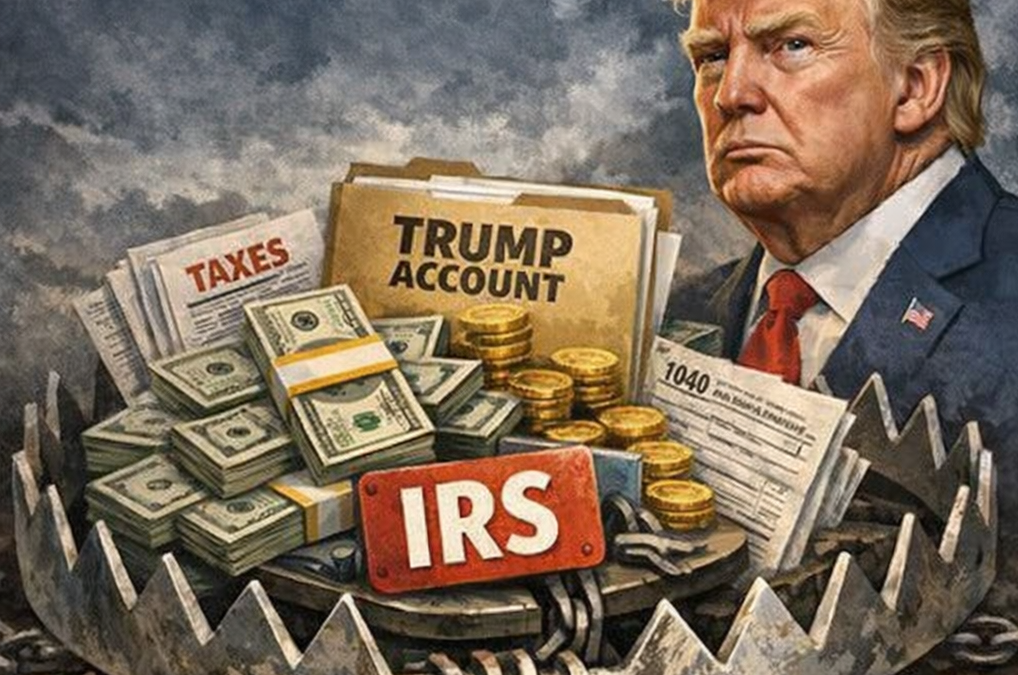
Starting July 4th, Trump Accounts will go live, and opening one for any child born between 2025 and 2028 is an absolute no-brainer. For many in Kansas, it may also make sense for children born between 2016 and 2025. Most people probably should not contribute anything additional themselves, however, due to tax complications and pitfalls.
Let’s start with the free money. Trump Accounts can be funded by one of three groups: you, your employer, or an entity such as a charity or the government. Currently, the federal government will contribute $1,000 to a Trump Account for any child born between January 1, 2025, and December 31, 2028. This process does not happen automatically, though. You must fill out Form 4547 and open an account through InvestAmerica.org to receive the money.
Additionally, billionaire Michael Dell, of Dell Computer fame, has pledged to give $250 to the first 25 million children under age 10 who were born prior to 2025 and are not eligible for the $1,000 from the federal government. You must also reside in a ZIP code where the average household income is under $150,000, which would include most ZIP codes in Kansas. Because of an odd rule for Trump Accounts, your actual income does not matter for eligibility purposes. Nonprofits and charities can elect to donate to Trump Accounts by region or age, but they cannot discriminate based on a particular person’s income. That is why Michael Dell stipulated his donation only go to accounts of children who reside in ZIP codes to try and minimize the amount given to higher income families.
If your child is eligible for either $250 or $1,000 of essentially free money, you should sign up for a Trump Account. The same goes if a different charity or local government decides to make contributions your child would be eligible for. Your employer may also contribute up to $2,500 per employee, per year. So, if you and your spouse each work for the same employer and you have one child, that employer could contribute up to $5,000 per year for that child. If only one person’s employer is contributing and you have multiple children, that employer can contribute only $2,500 in total, split among your children. If that sounds confusing, arbitrary, and counterintuitive, I certainly understand. Much of the tax code the government has created is exactly that.
One downside to this “free money” is that taxes eventually have to be paid not only on the contributions, but also on all of the growth. In addition, 100% of whatever the account is worth when the child turns 18 becomes fully controlled by that child, and they can do whatever they want with it. For some families, that could be a scary proposition.
Essentially, at age 18, Trump Accounts begin following the same rules and restrictions as any other pretax IRA-style investment account. If the money is withdrawn before age 59 1/2 and not used for some type of qualified exception, such as a first-time home purchase or higher education, there is an additional 10% tax penalty on top of whatever other tax is owed. Even if the money is used for a qualified reason, tax is still owed — just not the additional penalty. Also, as with an IRA, there are RMDs, or required minimum distributions, that will start at age 75 for anyone who has a Trump Account. Balances in a Trump Account could also potentially reduce or disqualify a child from receiving financial aid for college.
Even if some value is lost to taxes or a reduction in financial aid, it is still a good idea to sign up children who qualify for free seed money, because they would still have what is left over rather than nothing. What is not a good idea for most families is contributing money to a Trump Account out of their own pockets.
One reason is the significant tax complication it creates — a complication that would not otherwise exist if the account only ever received pretax money from someone else. While contributions from the government, charities, and employers are considered pretax, any contributions a family makes themselves are considered after-tax, and there is no tax break for making those contributions. It also means that every year going forward — which for most families would span decades — it must be reported on a tax return how much was contributed by you on an after-tax basis and how much is pretax.
As an example, let’s say you start a Trump Account today for a child born this year. They receive the free $1,000 from the government, and then you decide to contribute $2,000, bringing the total balance to $3,000. Let’s also say that, over time, that $3,000 grows to $10,000 and a withdrawal then takes place. Because there was $2,000 of after-tax money contributed to the account, and because $2,000 represents 20% of the current account balance that would mean 80% of any withdrawal would be taxable and 20% would not be, since that 20% had already been taxed. So, if $6,000 were withdrawn, $4,800 would be taxable and $1,200 would not.
This further complicates future withdrawals, because $1,200 of the original $2,000 in after-tax contributions is now gone, leaving only $800 in after-tax money. So, if the remaining $4,000 in the account were to grow to, say, $12,000 in the future, then $800 — or 6.67% of any withdrawal at that time — would be tax-free.
See how quickly this can get complicated? Because it becomes so complicated so quickly, what is likely to happen is that many people who decide to make additional contributions above and beyond the free money will not properly track how much of an account is pretax and how much is after-tax. As a result, they may end up paying tax later on money they contributed themselves and accidentally pay tax on the same money twice. Even if meticulous tracking is done, any contributions a family makes will likely have a higher tax rate assessed on gains when the money is eventually withdrawn compared with other already available alternatives.
Next month, we’ll detail the pros and cons of four different account options with more favorable tax treatment than a Trump Account that can be set up for the benefit of a child. If you do not want to wait until next month to learn more, you can set up a complimentary strategy session with a financial advisor on our team at Retirement Portfolios in Lawrence by filling out the form below.
Material discussed is meant for general/informational purposes and is not intended to be used as the sole basis for any financial decisions, nor be construed as advice to meet your particular needs. Please consult a financial professional for further information
Recent Comments