
Last month, we walked through a scenario that surprises most retirees: being in a lower tax bracket in retirement while paying a higher effective tax rate on withdrawals from pretax retirement accounts. If you missed it, start there first. Today, we’ll focus on the most powerful tool for fixing that problem: the Roth.
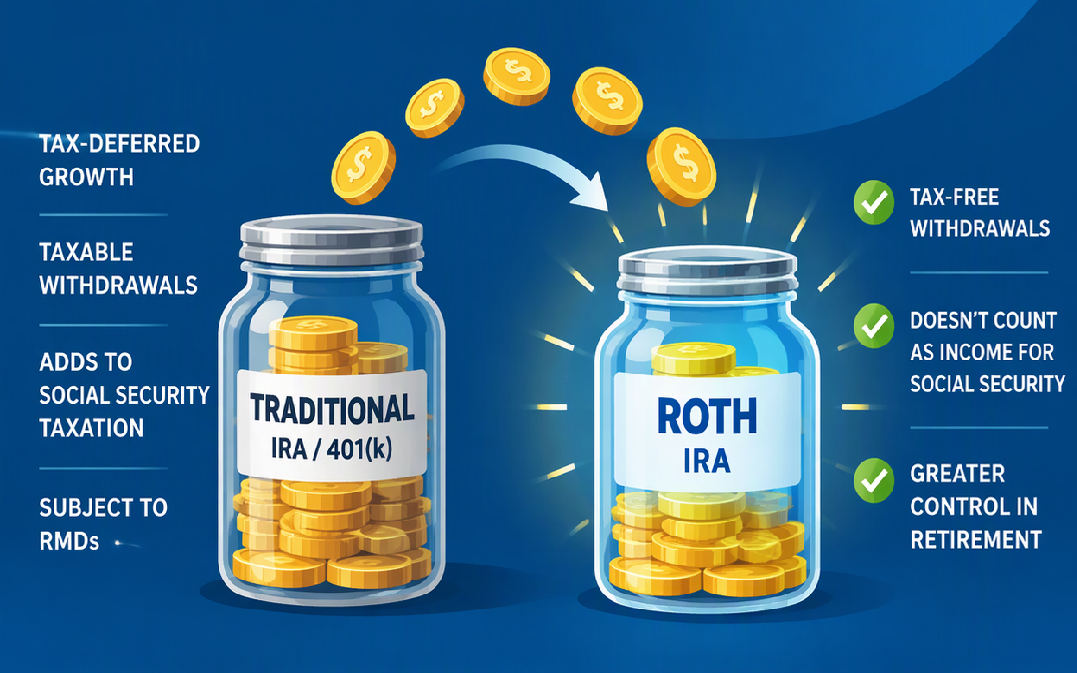
Roth withdrawals are tax-free and importantly don’t count as income in the formula that determines how much of your Social Security gets taxed. This is the opposite of a pretax, traditional retirement account where every dollar you withdraw not only is taxable, but adds to that calculation.
If you already have significant balances in traditional tax-deferred accounts like an IRA or 401(k), a Roth conversion where you pay taxes on a portion of that money now and move it into a Roth where it will never be taxed again could be a powerful move. You can convert any amount (it doesn’t have to be all at once) giving you precise control over how much taxable income you recognize each year.
For people approaching retirement, there’s often a valuable window that can be taken advantage of between when you stop working and when you can delay Social Security beginning. During this period, your income may be lower than it’s been in years and may be an ideal time to execute conversions — paying tax at a lower rate now, before Social Security income, Required Minimum Distributions (RMDs), and other retirement income sources all arrive at once and collide in ways that are difficult to unwind.
Under current law, RMDs begin at age 73 (or 75 if you were born in 1960 or later). These mandatory withdrawals from traditional accounts are fully taxable, and if your balances are large, they can push your income high enough to trigger additional taxation on Social Security whether you need the money or not. Waiting passively for that to happen is one of the most common and costly mistakes in retirement planning. Even if you’ve already started Social Security, you can turn it back off if you’re past your full retirement age and it’s advantageous to do so from a tax planning perspective.
The right amount to convert each year depends on your income, your account balances, your Social Security benefit, capital gains exposure, dividends, interest, state taxes, and more. Social Security income, ordinary income, and capital gains are all taxed under different rules, and they interact with each other in ways that make one-size-fits-all guidance impossible. There is no universal formula or answer. What is universal is that a good tax plan with average investments will nearly always outperform great investments with no plan at all. Paying an effective rate of 44% on retirement account withdrawals, which is surprisingly common for middle and upper middle class retirees that don’t or poorly plan, instead of 12% requires an extraordinary amount of additional investment return just to break even. There’s certainly no guarantee that such outperformance ever materializes either.
Having a plan that accounts for taxes is not optional if you want to maximize what you actually keep and can spend in retirement. The sooner you begin the more impactful proper retirement tax planning can be, but it’s rarely too late to make some sort of meaningful improvements.
This material is intended for general informational purposes only and should not be considered personalized financial, tax, or legal advice. Please consult a qualified professional before making decisions based on this content.
Want to see what a smarter tax plan could mean for your retirement? Call 785-330-9292 or fill out the form below to schedule a complimentary review with a member of our team at Retirement Portfolios in Lawrence, KS.
Recent Comments