
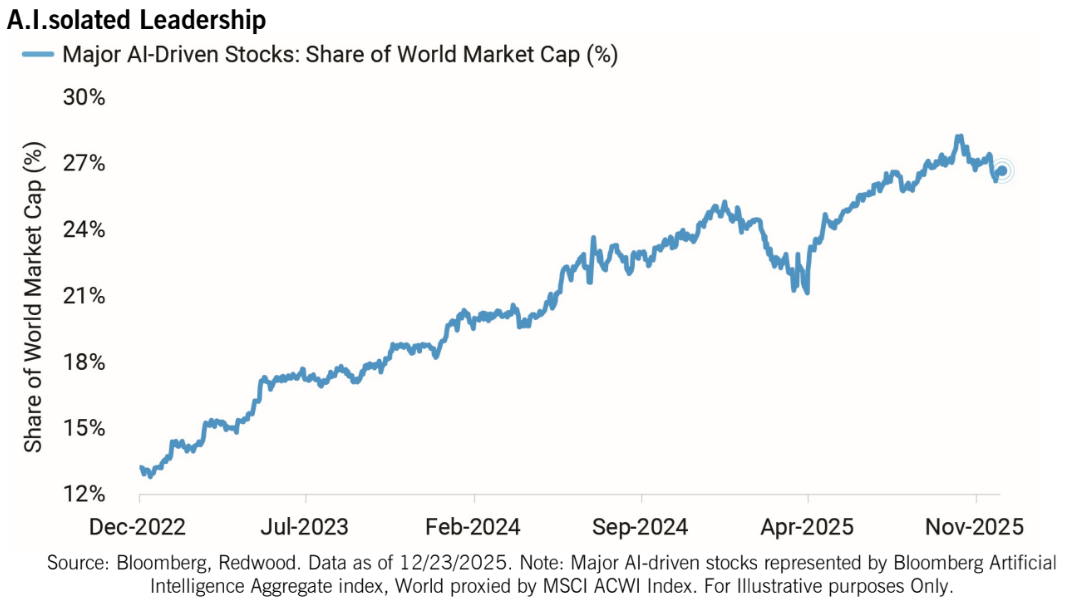
Google searches for the term “AI bubble” have been skyrocketing of late, which should come as no surprise when nearly 80% of the gains in the US stock market came from AI related businesses last year. The growth of AI stocks over the last 3 years is reminiscent to the last 3 years of the 90’s when dot com stocks soared and has been so large that AI stocks have more than doubled their share of the global stock market over this time period. Just five stocks (Nvidia, Google, Apple, Microsoft, and Amazon) now comprise a mind blowing 30% of the value of the S&P 500.
The S&P 500 is actually not an index of the largest 500 companies in America owned equally. Instead, the larger a company, the larger share it is of this index. The largest companies are all AI related, make up such a large share, and have all taken off over the last 3 years, as such, the S&P 500 index has seen tremendous growth over this period. It has also made the extreme concentration of just a handful of stocks much worse as the average company is not doing so well in comparison. About 200, or a staggering 40% of stocks in the S&P 500, declined in value and lost money last year.
Given these statistics, it is no wonder some are beginning to worry. While history doesn’t always fully repeat itself, it does often rhyme. The prices of these AI stocks relative to how much the companies are actually earning in profits are at levels not seen since right before the dot com boom went bust.
Two big differences between AI stocks now and dot com stocks then is that AI stocks have minimal debt compared to many dot coms, and also have large and impressive profitability. Most dot coms had zero profits and investors were just hoping they would eventually become profitable. Still, the assumption that the large AI stocks will continue to see record profits, when a recent report by Nanda of MIT’s Media Lab showed that 95% of organizations are getting zero return on AI investment thus far, is far from a sure thing.
So what should someone saving for, near, or in retirement do with their nest egg now given all this?
1) Consider diversifying out of index funds, like the S&P 500 that are not so diversified anymore. Many ‘target date’ retirement funds found in 401ks have the same problem of too much exposure to a handful of large AI related companies and thus too much risk. While many of these businesses are solid companies that are likely to succeed over the long term, having too many eggs in a single or similar baskets is rarely a good idea.
2) When looking at where to diversify elsewhere, consider the secondary benefactors that will do well if the AI hype does come to fruition, but won’t fall apart if they don’t, such as utilities. AI uses a lot of power and will use a lot more if the boom continues. The average utility company won’t go bust, though, if history does end up rhyming with AI stocks going the way of the dot coms in the early 00’s.
3) Have a plan. Don’t get caught up in the hype. More wealth is lost to fear and greed in financial markets than to anything else. Retirement plans shouldn’t be built on hoping you correctly guess what any one stock, one type of stock, or even the stock market as a whole may do in any given short term time period. Instead, a retirement plan should be designed to succeed and provide ever increasing income over the long term regardless of what happens in the short term. If you need help creating such a plan, call 785-330-9292 or fill out the form below to schedule a complimentary strategy session with one of our financial advisors as that is exactly what our team does at Retirement Portfolios.
Recent Comments